

Use case 3
Safe and Sustainable by Design

Goal
The Safe and Sustainable by Design (SSbD) framework aims to include environmental, societal and economical effects into the chemical and materials design process, in order to simultaneously achieve safer and more sustainable industries and materials.

Partners involved
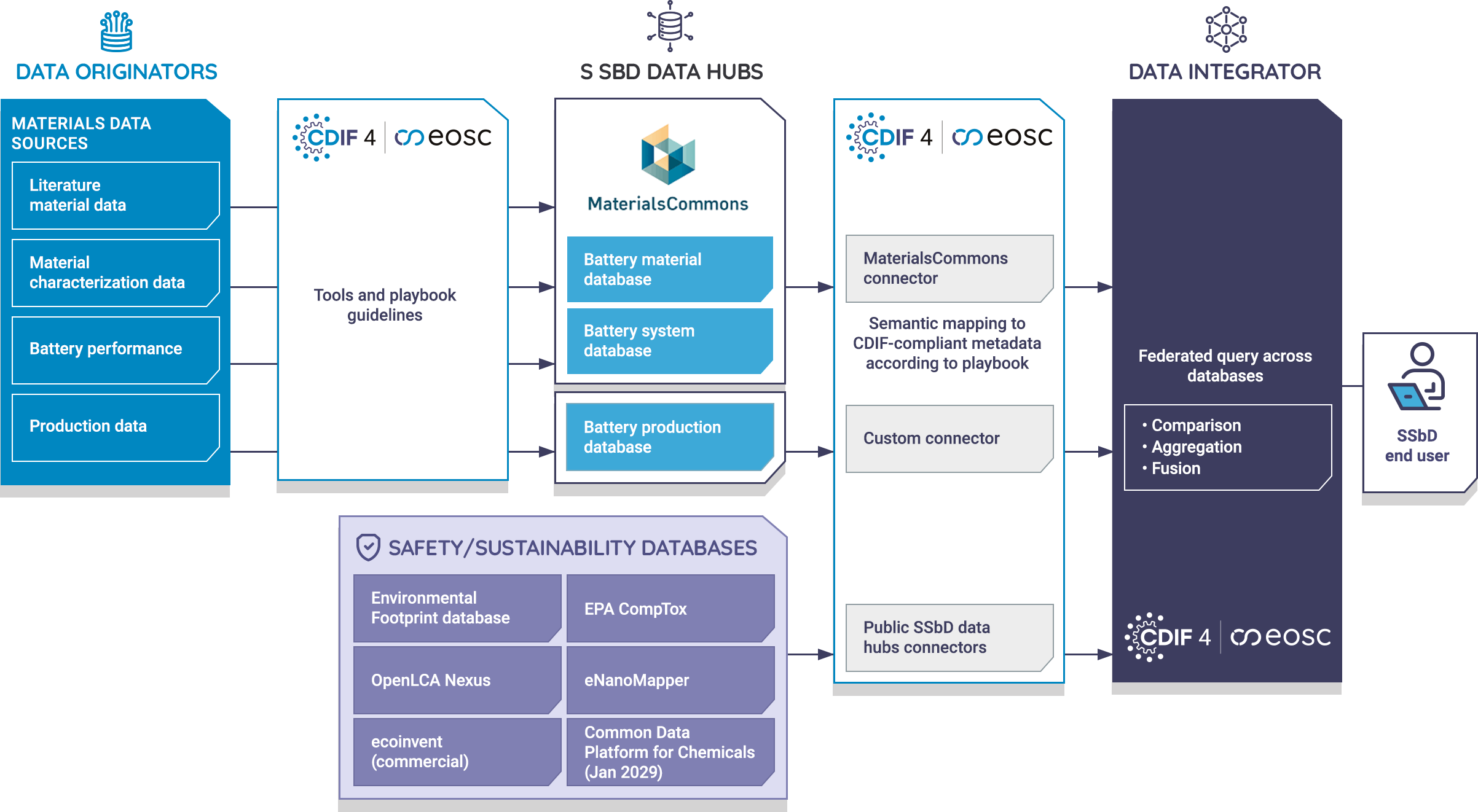
The Safe and Sustainable by Design (SSbD) framework aims to include environmental, societal and economical effects into the chemical and materials design process, in order to simultaneously achieve safer and more sustainable industries and materials. This is an intrinsically cross-domain problem, as it relies on data through the processing chain, from raw materials to end of life, materials characterization and modelling, as well as regulatory risks. In order to use SSbD for battery optimizations problems, we need not only battery characterization data, but also data about the safety of the used chemicals to produce the anode, cathode and electrolyte, the environmental impact of the battery production process, and the safety and recyclability of the materials used, to name a few.
Data integration is an important aspect, since the data comes from many data sources and represents the same data in multiple representations with different names, units and formats. Before the data can be used in SSbD, it must be harmonized and made interoperable. The use case includes confidential industrial data sources, so controlled data access is also an important aspect.
Additionally, when working with multiple data sources, it is important to have tools that checks the data quality and keeps the provenance of data points, so the SSbD designers don’t discard promising candidates based on a low quality data point, and can update the results with the release of new databases.
Use Case 3 will attempt to address these issues for a battery production use case.
The CDIF4EOSC playbook will be used to guide the documentation of data under our control, including MaterialsCommons, which aims to create a federated European digital infrastructure for advanced materials and the OLiMPUS project. MaterialsCommons has a dedicated use case on batteries that will serve as a data source, while OLiMPUS will serve as both data source and data consumer for UC3. The playbook also sets the requirements for the connectors that are connected to the various data hubs, where the connectors will ensure that the data is CDIF compliant. The end user will interact with the data hubs with federated queries to aggregate, compare or fuse data from various sources.