

Use case 2
Social Sciences & Environment

Goal
Address the traditional challenges of integrating diverse datasets, which vary in format, sensitivity, and vocabulary, by using the CDIF4EOSC Playbook to reduce the labor-intensive “data wrangling” usually required by researchers

Partners involved

The standard model for cross-domain data linkage is either for a third party to perform it on behalf of the researcher as an expensive and slow boutique exercise, or for the researcher to do it themselves and spend more time on tedious data-wrangling than on doing actual research. This has traditionally been a necessary evil due to the serious lack of granular metadata in a number of key areas that are essential to support such online linkage operations. These areas are principally (1) privacy and rights metadata necessary for effectively managing the disclosure risk of combined datasets (2) structural metadata essential for the integration of data in different dimensional formats, and (3) rich variable metadata with standardised concepts/units-of-measure which enable meaningful comparison of variables and their function across data sourced from different organisations and/or disciplines.
CDIF provides the framework for establishing a comprehensive approach to leveraging existing metadata and data standards to finally empower real-time subsetting and linkage of cross-domain data for researchers. Let’s move on from Discovery and AI-enabled “magic search” and start to properly address rights management, provenance, semantic descriptions at the variable level, and structural integration mechanisms that go beyond file format converters. CDIF4EOSC is the project that will provide the tooling and services to enable repositories and data stewards to create robust CDIF resources without having to be professional software or AI engineers, information modellers, or ontologists.
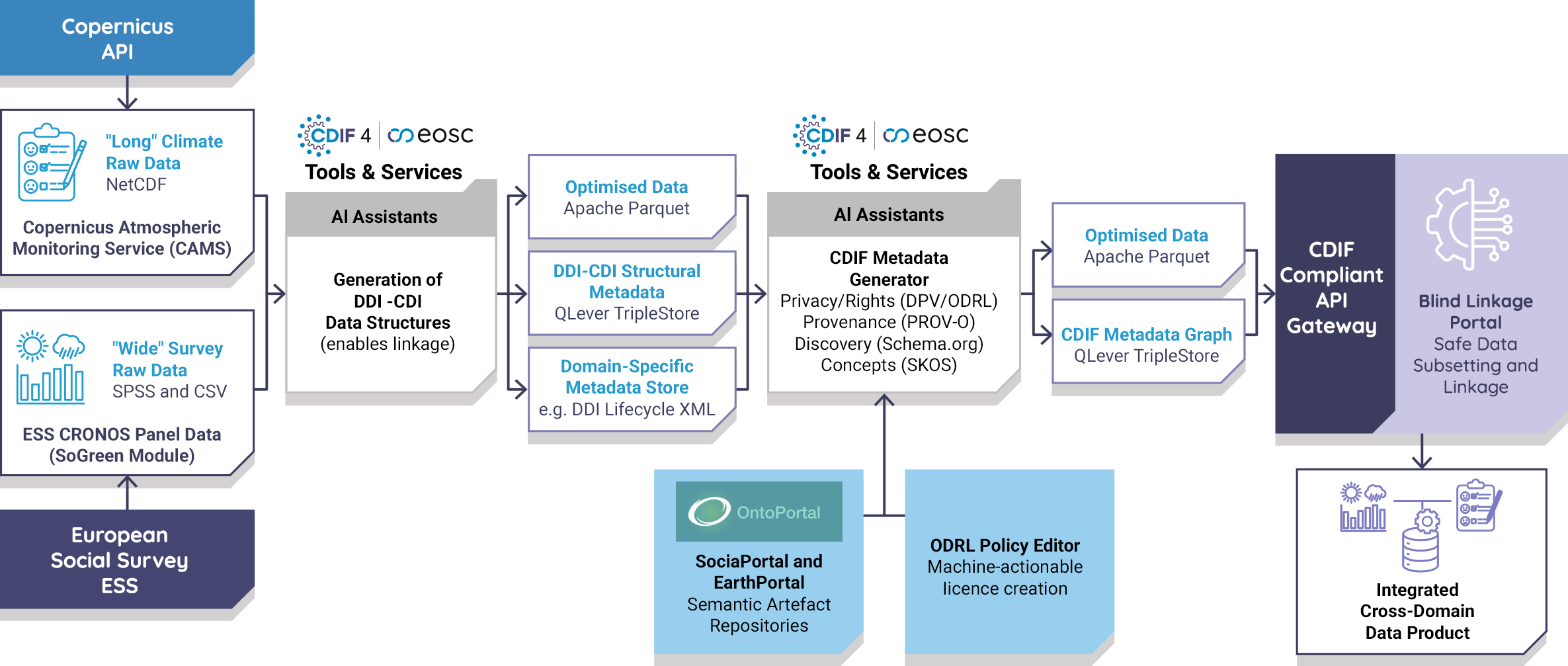
Use Case 2 takes two domains (Social Sciences and Environmental Sciences) with well-established subject matter integrations and demonstrates how “long” climate data from Copernicus and “wide” survey data from European Social Survey (ESS) CRONOS Panel can be processed through a CDIF4EOSC pipeline resulting in a significantly enriched and standardised set of digital resources at both the structural and semantic level. This allows researchers to interrogate, subset, and link data more subtly and intelligently, in order to investigate cross-domain research topics such as attitudes to climate change. We refer to this as “blind linkage” as the researcher never sees potentially disclosive material such as high-resolution geospatial data but critically, they can still leverage it to identify where data can be meaningfully combined. The diagram illustrates the core principle for ESS and Copernicus Data but this CDIF ingest, enrichment and dissemination pattern will also be applied to more metropolitan-level data in Athens, combining Energy Poverty Indicators with local surveys, and to national-level data in the Netherlands, combining data to investigate social attitudes in relation to environmental noise exposure.